Jay Smeets
Contact Jay Smeets, or one of our other experts, to discuss your RFID needs and how they fit your project.
+31 (0)36 535 0070
Contact us
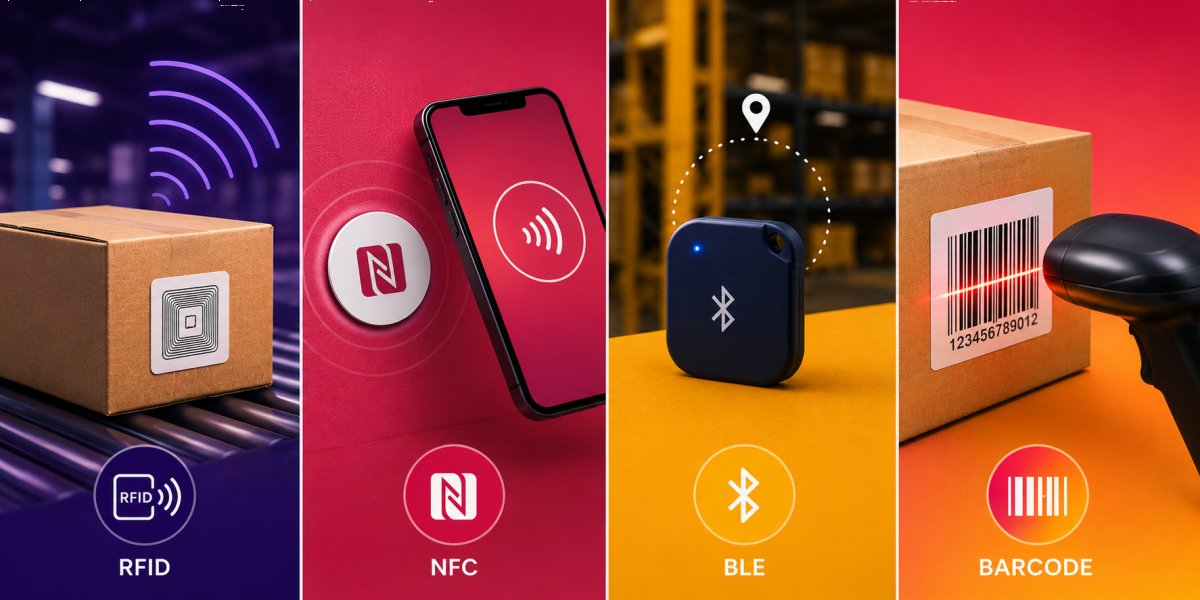
RAIN RFID, barcode, NFC and Bluetooth Low Energy (BLE) are used for different types of identification, interaction and tracking. The right technology depends on the application, required reading distance, number of items and the level of automation required.
With this overview, the key differences between RAIN RFID, barcode, NFC and BLE become easier to compare.
| Feature | RAIN RFID | Barcode | NFC | BLE |
|---|---|---|---|---|
| Best suited for | Identification and tracking | Identification | Short-range interaction and identification | Connectivity, proximity and tracking |
| Reading method | Radio frequency | Optical | Near-field wireless communication | Wireless communication |
| Line of sight required | No | Yes | No | No |
| Bulk reading | Yes | No | Generally no | Not designed for bulk identification |
| Typical range |
Typically from centimetres up to several metres, depending on system and environment |
Close to several metres, depending on scanner/code | Typically a few centimetres | Typically several to tens of metres, depending on implementation |
| Power required | Passive or battery-powered | No | Passive or powered | Usually battery-powered |
| Typical applications | Inventory, logistics, asset management | Product identification, logistics | Access, payments, product interaction | Asset tracking, RTLS, connected devices |
The technologies are not direct alternatives in every application. RFID and barcode are primarily used for identification, NFC is designed for very short-range communication, while BLE provides wireless connectivity and can be used for proximity and location-related applications.
RFID and barcode are both used to identify products and assets, but the way they are read is different.
A barcode is optically scanned and normally requires a clear view of the code. RFID uses radio frequency communication and does not require direct line of sight. RAIN RFID systems can also identify multiple tagged items within a read zone. This makes RFID particularly suitable for automated processes such as inventory management, shipment verification and item-level identification. Barcode remains a practical solution where individual scanning is sufficient and a simple, low-cost identification method is required.
Which one fits your application?
Choose RFID: if you need automated identification, multiple-item reading or identification without direct line of sight.
Choose barcode: if items can be scanned individually and a simple optical identification method is sufficient.
For an example of an RFID implementation replacing barcode-based processes, see our case study: From Barcode to RFID
NFC is a short-range wireless technology designed for communication between devices or tags at very close distance.
RFID is a broader technology category with different frequency ranges and applications. RAIN RFID, for example, is commonly used for automated identification of tagged items, while NFC is often used when a person actively interacts with a tag or device.
Which one fits your application?
Choose RFID: if products or assets need to be identified automatically, particularly when multiple items need to be read.
Choose NFC: if a person needs to interact with a product or device at close range, for example for access control, product interaction or smartphone-based experiences.
RFID and BLE can both be used in tracking applications, but they serve different purposes.
RFID is commonly used to identify tagged objects when they pass through a defined reading area. RAIN RFID is widely used for inventory, logistics and asset identification.
BLE provides wireless communication between devices and can be used for proximity detection, asset tracking and real-time location systems. The achievable range depends on the BLE implementation, hardware and environment.
Which one fits your application?
Choose RFID: if the primary requirement is to automatically identify tagged items within a defined reading area.
Choose BLE: if wireless connectivity, proximity detection or location information is an important part of the application.
Yes. Different technologies can be used alongside each other when an application requires different types of identification, interaction or tracking. For example, RFID and barcode can be combined when both automated identification and individual scanning are needed. RFID and NFC can also be used together when automated identification and direct user interaction are both required.
Not necessarily. RFID covers different technologies and frequency ranges, so the achievable read range depends on the type of RFID system, tag, reader, antenna and environment. NFC is specifically designed for communication at very close range, while some RFID systems, such as RAIN RFID, can operate over considerably greater distances.
It depends on the technology and the smartphone. Many smartphones support NFC and Bluetooth, allowing them to interact with compatible NFC tags and BLE devices. RAIN RFID tags, however, generally require dedicated RAIN RFID reader hardware and cannot normally be read directly by a standard smartphone.
RAIN RFID is generally the most suitable of these technologies when multiple tagged items need to be identified automatically within a read zone. Barcode and NFC typically involve individual interactions, while BLE is designed for wireless communication and proximity or location-related applications rather than bulk item identification.
BLE can be used as part of a real-time location system (RTLS) when continuous or frequent location or proximity information is required. The achievable accuracy and range depend on the BLE infrastructure, hardware, configuration and environment. RFID can also support tracking processes, but is commonly used to identify items at specific read points or within defined read zones rather than provide continuous location information.
In many cases, yes. RFID does not require direct line of sight, so tags can often be identified through materials such as cardboard or plastic. Read performance depends on the RFID technology, tag, packaging material and surrounding environment. Metal and liquids can significantly affect the performance of some RFID systems, particularly RAIN RFID, so testing in the intended application is recommended.
Cisper supplies RAIN RFID, NFC and BLE hardware for identification, tracking and automation applications.
For RFID-based identification, explore our RFID Labels. For wireless tracking and connectivity, explore our BLE Beacons & Wireless IoT products.
Not sure which technology or hardware fits your application? Contact our experts for advice.